Description
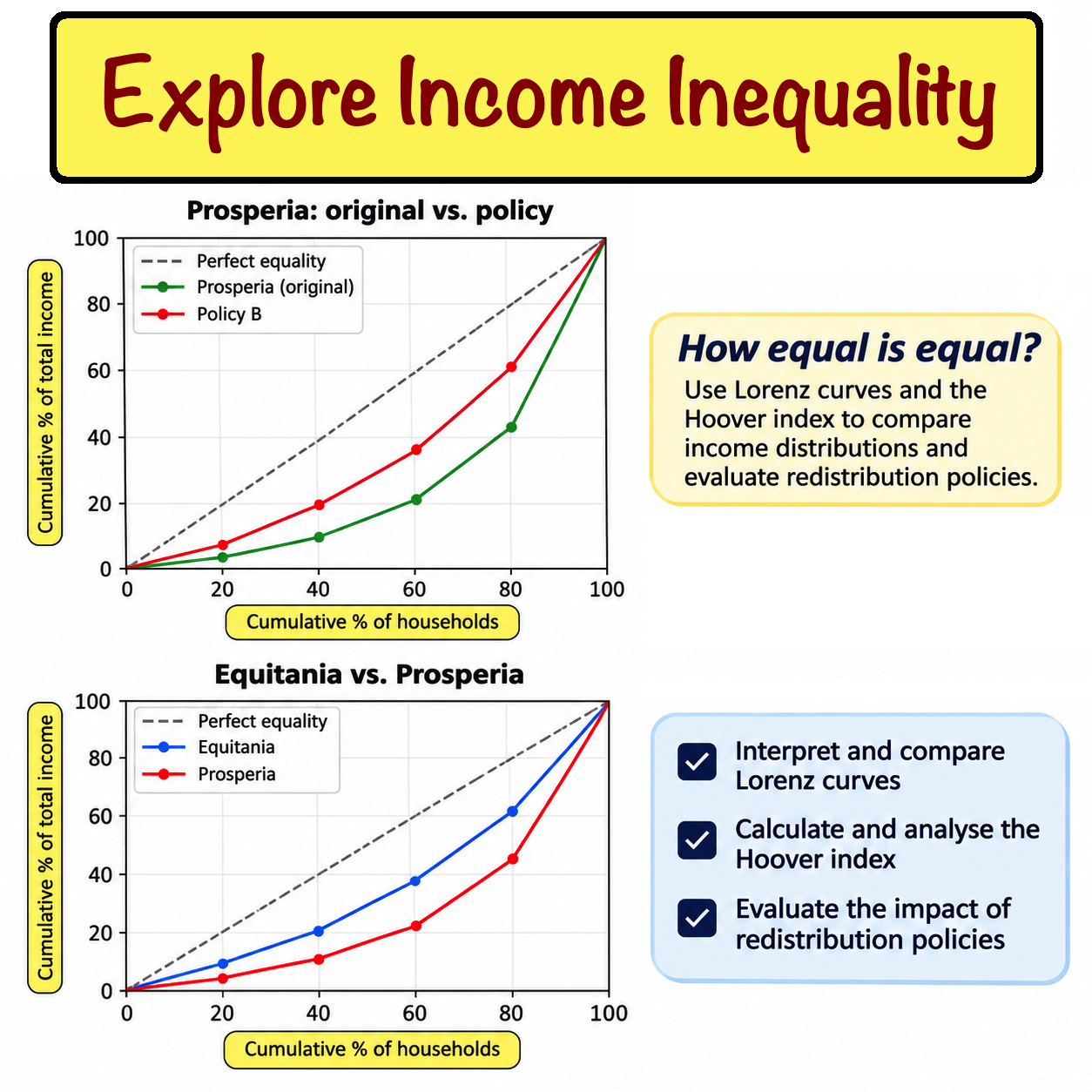
In this assessment, students investigate income inequality in two fictional countries by calculating cumulative income percentages, constructing Lorenz curves and determining Hoover indices. They use their findings to calculate the amount of income requiring redistribution to achieve perfect equality under a simplified model. Students then investigate two alternative redistribution policies, comparing their effects on income distributions and Hoover indices. They discover that identical Hoover indices can represent different income distributions, before evaluating the accuracy, limitations and real-world implications of their mathematical models.
Grade Level
MYP5S
Criteria
D
Criteria Level
MYP5
Math Concepts
mathematical models
evaluating models
cumulative frequency graphs
percentages
cumulative frequency tables
proportions
MYP Global Context
Fairness and development
MYP Key Concepts
Relationships
MYP Mathematics Related Concepts
Models
Validity
Representation
Report Format
Scaffolded
Solution Type
Closed-ended
Estimated Time
75-90 mins